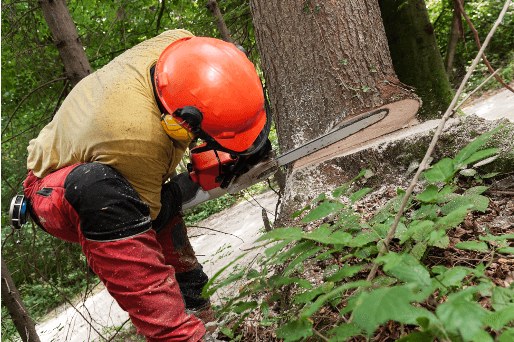
Outdoor workers know your rights with accident claims

HSE Warn Forestry Workers

HSE has reminded people working in the forestry industry of the importance of site specific planning following the prosecution of a Herefordshire timber firm which was fined after a worker was crushed against a machine by a tree trunk.

The 24-year-old forestry operator, who has asked not to be named, fractured his hip and damaged a knee in the incident at Westhide Wood on 24 August 2012.

He was hospitalised for two weeks, and has had to seek alternative employment in another industry because he can no longer do manual work. He is also no longer playing sport at the level he used to.

On 11 August, Hereford Magistrates’ Court heard that he was one of a two-man team working for Leominster-based Chalford Timber Ltd. One was using a large forestry vehicle called a forwarder to crane trees into position to enable the injured worker to chainsaw the trunks into three-metre lengths.

One tree became tangled in the branches of another as it was being moved and when it broke free hit him, forcing him against the machine.

An HSE investigation found the company had not followed established industry procedures to ensure no-one was within the “risk zone” of the machine while it was in operation. The operator of the machine should have ensured that the man on the ground was clear of the designated working zone, in a safe area and in view.

Chalford Timber Ltd, of Nordan, Leominster, Herefordshire, was fined £8,000 and ordered to pay £16,335 in costs after pleading guilty to breaching section 3(1) of the Health and Safety at Work etc Act 1974.

After the hearing, HSE inspector Christopher Gregory said: “This was an incident that should have not have been allowed to occur. Forestry practices are high risk and potentially dangerous, and those who work in the industry should be fully aware of the risks. Workers and machinery should, wherever possible, be kept well apart due to the unpredictability of the work and the consequences of what can happen if it goes wrong.

“There is long established guidance for such work drawn up by the industry that confirms what a safe distance from working machinery should be. Any operator of such machinery knows the stop rule; if anyone approaches the danger zone, work must stop until the risk zone is clear. The key control is for the operator to be aware, at all times, where people are on the ground, and this relies on visual contact.

“Site specific planning is essential and control must be maintained at all times. The penalty for getting it wrong is not just financial – it causes unnecessary hardship and long term disruption to people’s lives.”


author avatar
Lyndsy Sword
Co-founder & Director at Wolf Law | SRA-approved Solicitor

How much compensation could you be owed?

If you’ve been involved in an accident, you could be owed compensation. Contact us today to determine the validity of your claim and find out how much you could be owed.

How much compensation could you be owed?

If you’ve been involved in an accident, you could be owed compensation. Contact us today to determine the validity of your claim and find out how much you could be owed.
Two professionals sit at a desk in a modern office; one facing the camera holds glasses while the other, with back to us, discusses documents.

Employment law changes 2026: what employers must prepare for

The Employment Rights Act 2025 is rolling out in stages, and the next set of employment law changes takes effect on 1 October 2026, with dismissal reforms following in January 2027. This guide from Wolf Law’s employment law team explains what has already changed this year, what is coming next, and the practical steps your business can take now to stay compliant. From doubled tribunal claim windows to new harassment prevention duties and uncapped dismissal awards, here is what every employer needs to know before the deadlines arrive.

Read More »
Doctor in a white coat with a stethoscope around the neck, holding and reviewing medical forms at a desk in a clinical setting with blurred lights in the background.

Sharp rise in NHS negligence claims for lack of informed consent

When you suffer an injury through no fault of your own, the legal process can feel overwhelming. Understanding your rights and the steps involved is essential for achieving a fair outcome. The case highlights the importance of seeking specialist legal advice when dealing with injury claims. This guide explains what you need to know and how Wolf Law can help you navigate the process.

Read More »
Two doctors in white coats review a tablet together during a patient consultation.

Medical Negligence Claims: What You Need to Know

If you have suffered harm because a medical professional failed to provide an acceptable standard of care, you may have grounds for a medical negligence claim. Understanding what qualifies as negligence, how claims work, and what you might recover is the first step. Wolf Law has helped many clients in England and Wales pursue these claims and secure the compensation they deserve.

Read More »
Surgeon in a sterile gown, mask and cap, handing instruments over an operating table in a dimly lit OR.

Unnecessary surgery claims: what patients need to know

A recent NHS trust claim highlights the questions patients may face after an operation that may not have been needed. This guide explains how medical negligence claims work, what evidence can help, and why early legal advice matters. It covers consent, clinical records, limitation periods, rehabilitation and the practical steps a patient can take after unexpected treatment. Wolf Law helps people understand their options through a free initial consultation, while each claim depends on its own medical evidence and legal facts.

Read More »